
An ice dam forms when heat leaking out of the house melts snow on the upper roof and the water refreezes at the colder eave, where it backs up under the shingles. In Kentucky the lasting fix is in the attic: air sealing, insulation and ventilation, plus an ice barrier at the eaves when the roof is replaced.
Ice dams are usually filed under northern problems, and Central Kentucky does not get Minnesota winters. It does get the exact conditions an ice dam needs, just for fewer days at a time. That is why a Lexington ceiling can stain in February on a roof that had no trouble the previous three winters. This guide covers how ice dams form, what Lexington’s own weather records show about the risk, what to do while one is on the roof, and what actually stops the next one.
Jump to: How they form · Kentucky winter data · Warning signs · What to do now · The permanent fix · Ice barrier and code · FAQ
How an ice dam forms
The U.S. Department of Energy’s Building America Solution Center names three conditions that must all be present: “snow on the roof; a poorly air sealed and/or poorly insulated attic; and freezing temperatures.” Take away any one of the three and the dam does not form.
The mechanism is a temperature split across the same roof. Paul Fisette of the University of Massachusetts Amherst Building and Construction Technology program describes it this way: the upper roof surface, toward the ridge, sits above freezing, while the lower part of the roof along the eaves sits below freezing. Snow melts from underneath on the warm section, the water runs downslope, and it refreezes when it reaches the overhang, which hangs outside the heated walls of the house.
Each melt and refreeze adds to a ridge of ice along the edge. Once that ridge is tall enough, new meltwater pools behind it. The University of Missouri Extension explains that this pooled water is forced to back up under the shingles, and lists the results as dislodged shingles, sagging gutters, damaged insulation and water stains on interior walls. North Dakota State University Extension adds ceiling stains, structural damage and mold to that list.
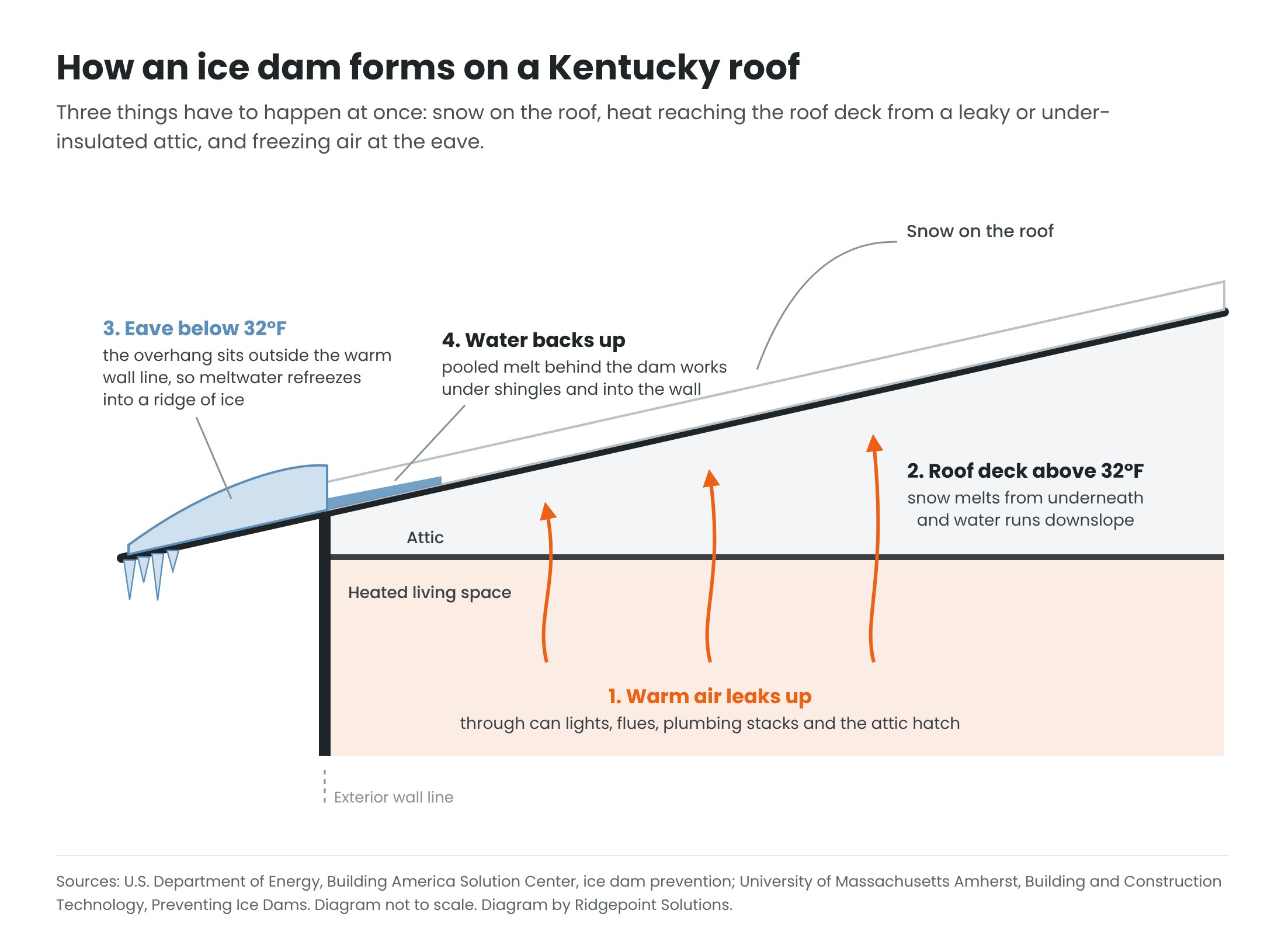
The heat that starts the process comes from the house, not the sun. Fisette puts it plainly: ice dams are created by heat lost from the house. Most of that heat reaches the attic as air, not through the insulation itself. The Building America Solution Center lists the usual openings as gaps around electrical wiring, light fixtures, especially recessed can lights, plumbing stacks, furnace flues and chimneys, along with attic hatches, dropped ceilings and kneewalls.
What Lexington’s weather records say about ice dam risk
NOAA’s National Centers for Environmental Information publishes 30-year climate normals for Lexington Blue Grass Airport, and they explain why ice dams show up here at all. In every winter month the average daily high stays above freezing, from 56°F in November down to 42°F in January. From December through February the average low drops below it, to 30°F, 25°F and 28°F. Across a full year, Lexington averages about 90 nights at or below 32°F.
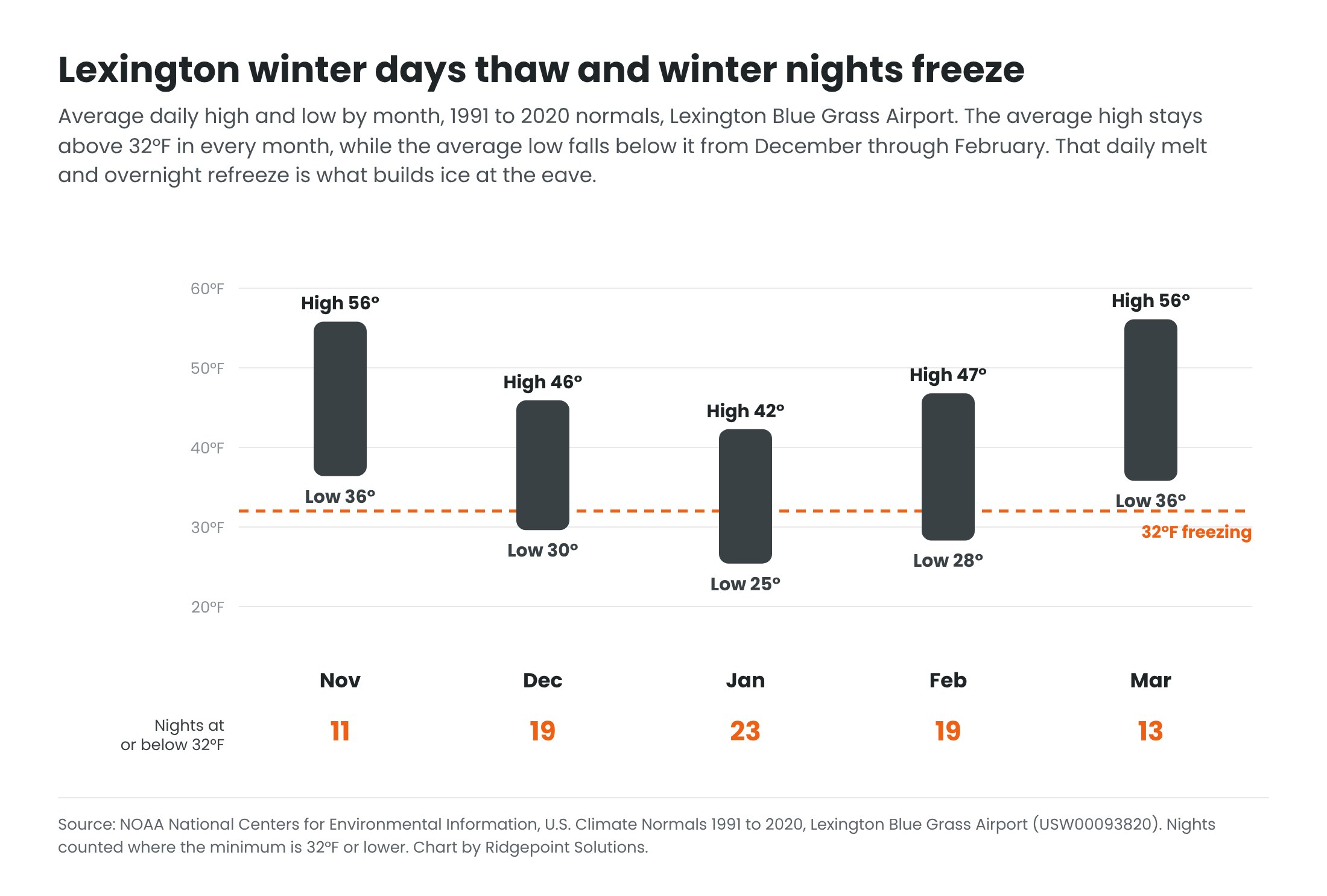
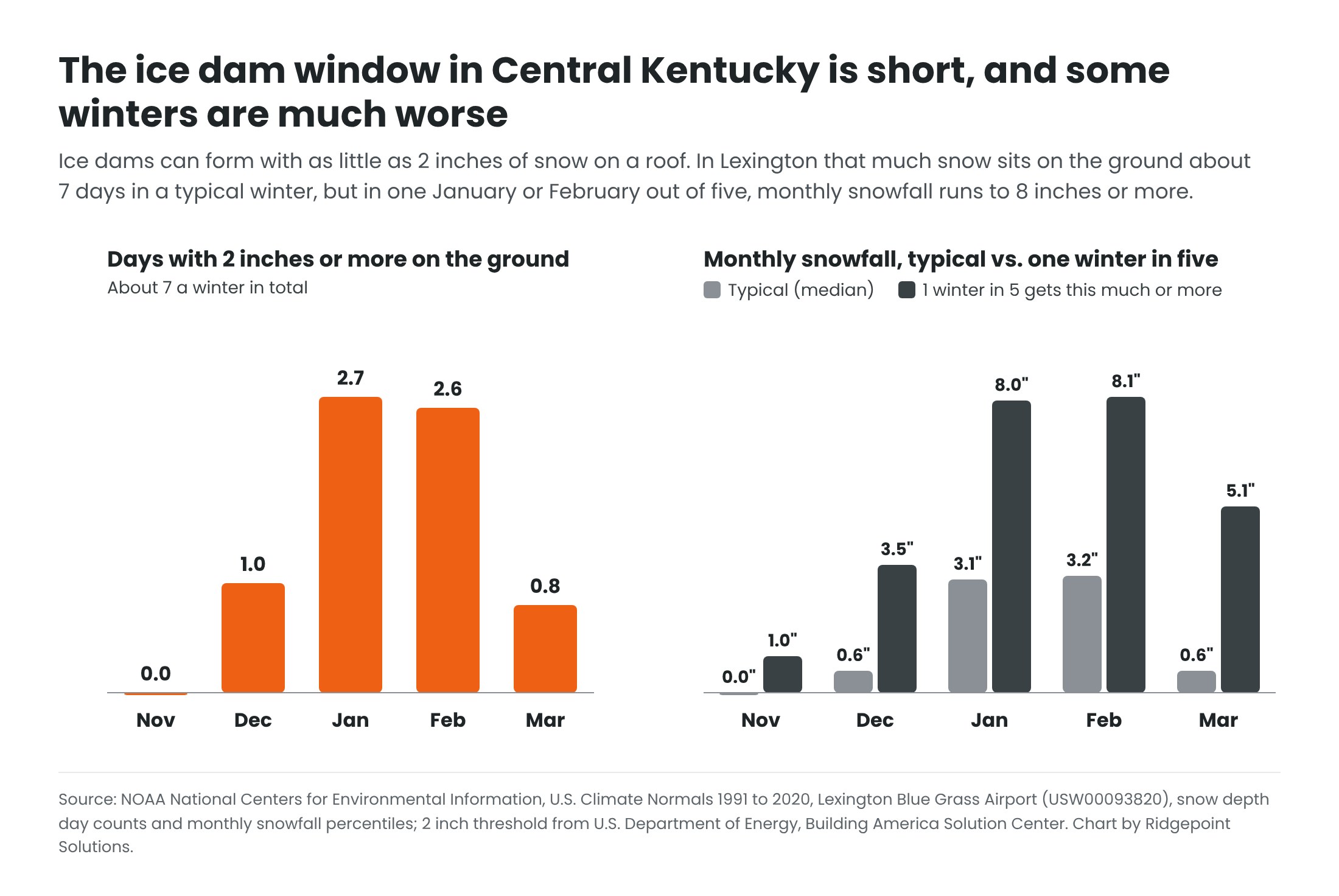
That pattern of thawing afternoons and freezing nights is the second of the three ingredients, and Central Kentucky supplies it almost all winter. The limiting ingredient here is snow. The Building America Solution Center notes that ice dams can form with as little as 2 inches of snow on a roof. The same NOAA normals show Lexington averaging about 7 days a winter with 2 inches or more of snow on the ground, concentrated in January and February.
Averages hide the bad years, and the bad years are when leaks happen. The NOAA monthly snowfall percentiles for Lexington put the typical January at about 3.1 inches of snow. One January in five brings 8.0 inches or more, and February looks almost the same at 8.1 inches. A heavy month like that, followed by sunny afternoons in the 40s and nights in the 20s, is a textbook ice dam week, and it reaches homes whose attics and eaves were never tested by the mild winters before it.
This is also why ice dams are worth separating from ordinary winter wear. Repeated freezing and thawing of trapped water loosens gutters and fasteners over many winters, a slow process covered in the guide to when gutters need repair or replacement. An ice dam is the fast version: a few days of snow cover can put water inside a wall.
Signs of an ice dam, outside and inside
The outside signs can be checked from the ground. Look for these, especially after a snow that sits on the roof for more than a day or two:
- A ridge of ice along the roof edge, often thickest above the gutters, with snow still sitting on the roof above it.
- Heavy icicles hanging from the eaves or the gutter lip. NDSU Extension notes that ice dams and icicles are most common when snow is on the roof and outdoor temperatures sit just below freezing.
- Bare stripes in the snow on the upper roof, which mark where attic heat is reaching the deck, often over rafter bays, can lights or a bathroom fan.
- Water stains or peeling paint on ceilings and walls near the outside walls, the pattern the University of Missouri Extension describes.
- Wet or matted insulation, or frost on the underside of the roof deck, visible from the attic hatch.
Stains near exterior walls during a thaw follow the eave line, which is where ice dam water enters. A stain in the middle of a ceiling points more often to a flashing, vent or pipe boot, and the roof leak repair page covers how those are traced. A stain directly under a skylight points to the curb and its flashing, which the skylights page covers.
What to do while an ice dam is on the roof
The short-term goal is to remove the snow that feeds the dam, without creating a bigger problem than the one already there.
Rake snow from the ground
Both NDSU Extension and the University of Missouri Extension recommend removing snow with a roof rake, and NDSU’s engineer Ken Hellevang advises homeowners to avoid getting on the roof. Clearing the lowest few feet above the eave removes the snow that would otherwise melt into the dam. NDSU also warns to watch for overhead power lines, since a long aluminum rake pole near a service drop is a real hazard.
What not to do
Do not chip or hammer at the ice. Fisette warns that in removing snow and ice from roofs, more damage is done to life, limb and roof in the process, and a chisel or hammer can cut straight through shingles. The University of Missouri Extension describes a gentler option, cutting channels through the dam with warm tap water from a hose, working up from the lower edge, and recommends leaving roof work to professionals because it can be very dangerous.
Heat cables are a common reaction, and the research is not kind to them. Fisette writes that an electric cable creates an ice dam just above it, that heat tape embrittles shingles and creates a fire risk over time, and that it wastes energy. NDSU describes heat tape as treating the symptom rather than the cause.
Protect the inside and document it
If water is already coming in, catch it, move belongings, and photograph everything. The Kentucky Department of Insurance’s storm guide tells policyholders to prevent further damage by covering the roof and removing water only if it can be done safely, to keep every receipt for tarps and wet vacuums, to take photos of the damage, and not to make permanent repairs until the adjuster has inspected. It also notes that most policies require claims to be filed within one year of the loss. The guide to what a roof insurance claim looks like in Kentucky covers deadlines, deductibles and matching, and the insurance claim roofing page explains how the inspection side works.
When water is actively entering the house, temporary protection matters more than anything else. The emergency roof repair page explains what a temporary dry-in involves.
The permanent fix happens in the attic
Every extension source cited here agrees on the long-term answer: keep the roof deck cold so the snow does not melt from below. The University of Missouri Extension states that the best way to prevent ice dams is to control heat loss from the home. Fisette frames the goal as keeping the entire roof below freezing if possible.
1. Air seal the attic floor
Sealing the openings listed by the Building America Solution Center (can lights, plumbing stacks, flues, chimneys, wiring holes and the attic hatch) stops the warm air that does most of the damage. NDSU Extension singles out recessed lights and attic access doors or ladders as common leak points.
2. Bring insulation up to current recommendations
The U.S. Department of Energy recommends R60 for an uninsulated attic in climate zone 4, the zone that covers Kentucky, and R49 where an attic already has 3 to 4 inches of insulation. The University of Missouri Extension gives a similar target of R-38 to R-49 for ceilings and roofs.
3. Ventilate from soffit to ridge
The University of Missouri Extension calls for at least 2 square feet of attic vent for each 150 square feet of attic area. Fisette describes a soffit-to-ridge system as the most effective way to cool roof sheathing, and the Building America Solution Center specifies an air gap of at least 2 inches between the top of the insulation and the underside of the roof deck, usually held open with baffles at the eaves. Insulation packed tight into the eaves blocks the soffit vents and leaves the lower roof warmer than it should be.
Vents and baffles are worth checking during a routine roof inspection, and blocked soffits are a common finding in roof maintenance visits. Gutters do not cause ice dams, and new gutters will not stop them, the University of Missouri Extension lists sagging gutters among the damage a dam leaves behind.
The ice barrier, and what Kentucky code requires
An ice barrier is a waterproof layer under the shingles at the eave, so that water backed up behind a dam has nowhere to go. It does not prevent ice dams. It limits what they can do.
The Kentucky Residential Code, adopted through 815 KAR 7:125, is built on the 2015 International Residential Code. Section R905.1.2 of that model code requires an ice barrier only in areas with a history of ice forming along the eaves, as designated in the local climatic design table. Where it applies, the barrier is either two layers of underlayment cemented together or a self-adhering polymer-modified bitumen sheet, running from the lowest roof edge to a point at least 24 inches inside the exterior wall line.
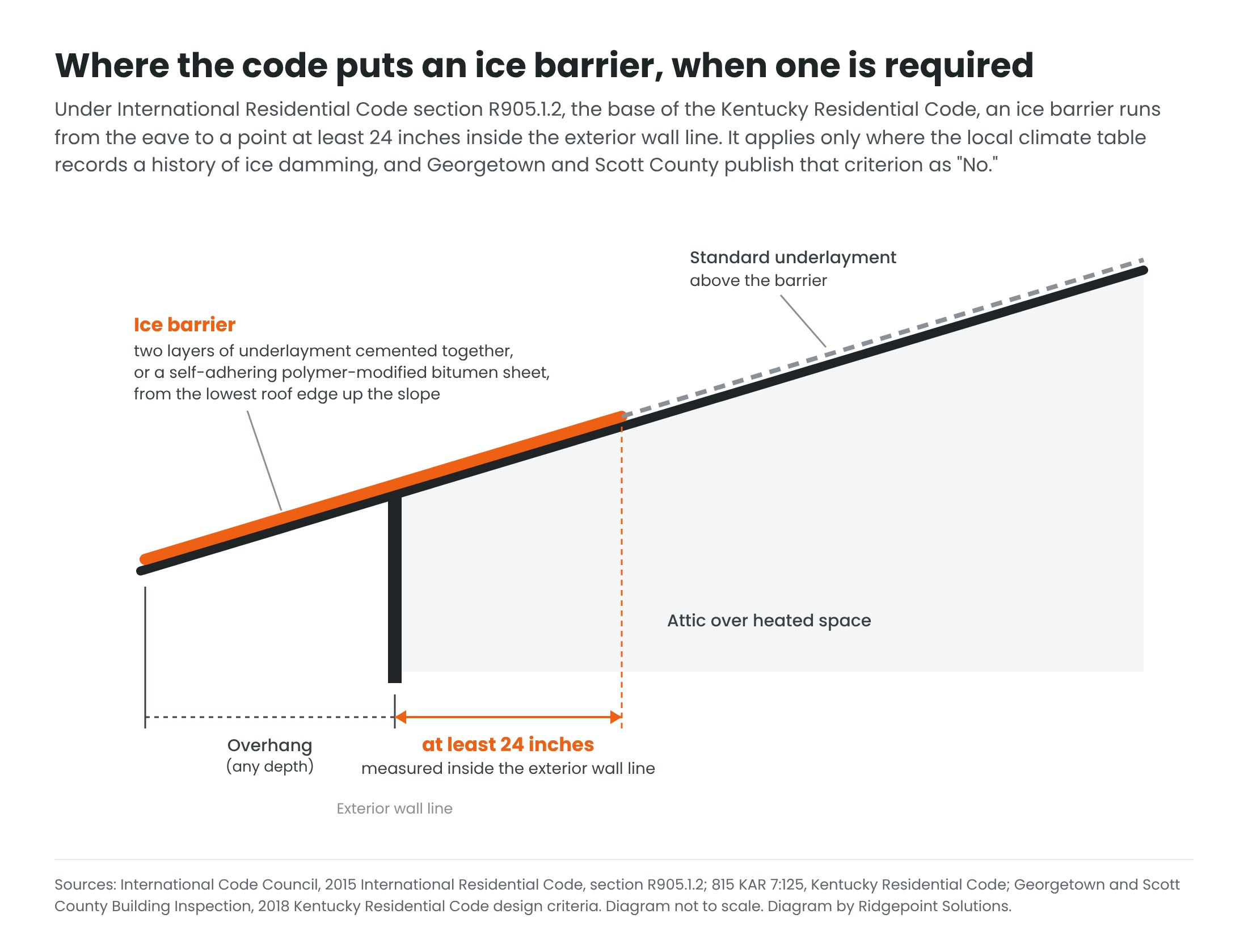
Whether it is required depends on the local table. Georgetown and Scott County Building Inspection publishes its 2018 Kentucky Residential Code design criteria with “Ice barrier underlayment required: No,” alongside a ground snow load of 15 pounds per square foot and a 24-inch frost line. A roof built to code minimum in an area like that can legally have no ice barrier at all, which is fine for most winters and is exactly the roof that leaks in the one-in-five winter.
Because the code requirement varies by jurisdiction, confirm the local design criteria with the building office that issues the permit. In Lexington that is covered in the guide to roofing permits in Fayette County. Whatever the local table says, a roof replacement is the one time the eaves are open, and it is the practical moment to ask for an ice barrier, whether the new roof is asphalt shingle or metal. Low-slope sections, porch roofs and valleys that trap snow deserve the same question, and flat roofing systems handle water in a different way altogether.
Common questions about ice dams in Kentucky
Do ice dams really happen in Kentucky?
Yes, though less often than in northern states. NOAA normals for Lexington show highs above freezing and lows below it through most of the winter, and about 7 days a winter with 2 inches or more of snow on the ground, the depth the U.S. Department of Energy says is enough to start one. In heavier winters the risk rises sharply.
How do you prevent ice dams?
Keep the roof deck cold. That means air sealing the attic floor, adding insulation to the Department of Energy’s recommended levels for climate zone 4, and venting from soffit to ridge with a clear 2-inch air gap above the insulation. An ice barrier at the eaves limits damage if a dam forms anyway.
Should an ice dam be chipped off the roof?
No. Chipping damages shingles and puts people on an icy roof. University extension specialists recommend raking snow off the lower roof from the ground and, if needed, melting channels through the dam with warm water. Roof work in icy conditions is best left to professionals.
Do heat cables stop ice dams?
They treat the symptom, not the cause. Guidance from the University of Massachusetts Amherst notes that a heat cable can create a new ice dam just above it, can embrittle shingles over time and adds a fire risk. Fixing attic heat loss addresses the cause.
Does homeowners insurance cover ice dam damage?
Coverage depends on the policy, so read the policy and call the insurer. The Kentucky Department of Insurance advises policyholders to protect the property from further damage if it is safe, photograph the damage, keep receipts for temporary repairs and avoid permanent repairs until the adjuster has inspected. Most policies require a claim within one year.
Is an ice barrier required on a new roof in Kentucky?
Only where the local climatic design table says so. The Kentucky Residential Code follows the International Residential Code, which ties the requirement to a local history of ice damming, and Georgetown and Scott County publish that criterion as not required. Check with the local building office, and consider one at the eaves regardless.
Getting a roof checked before the snow
Ridgepoint Solutions is a Lexington roofing company serving Central Kentucky, from Lexington to Georgetown, Frankfort and Richmond. If a home has had icicles, stains near the outside walls or bare stripes in the snow, we can look at the eaves, the flashing and the attic ventilation before winter, and explain what we find in plain language. If the roof is due for replacement, ask us about an ice barrier at the eaves as part of the scope.
To schedule an inspection, call 859-704-0094 or use the contact page. Questions about financing or storm damage are welcome on the same call.
Sources
- NOAA National Centers for Environmental Information, U.S. Climate Normals 1991 to 2020, Lexington Blue Grass Airport (USW00093820), monthly temperature, freezing-night, snow depth and snowfall percentile normals
- U.S. Department of Energy, Building America Solution Center, Attic Air Sealing, Insulating and Ventilating for Ice Dam Prevention
- U.S. Department of Energy, Energy Saver, Insulation, recommended R-values by climate zone
- Paul Fisette, University of Massachusetts Amherst, Building and Construction Technology, Preventing Ice Dams
- University of Missouri Extension, Ice dams on the roof can damage your home
- North Dakota State University Extension, Reduce ice dam and icicle damage (January 4, 2023)
- Kentucky Department of Insurance, Being prepared for natural disasters and knowing what to do after they happen (October 2024)
- Kentucky Legislature, 815 KAR 7:125, Kentucky Residential Code
- International Code Council, 2015 International Residential Code, Chapter 9, Roof Assemblies, section R905.1.2
- Georgetown and Scott County Building Inspection, 2018 Kentucky Residential Code design criteria