
A roof insurance claim in Kentucky runs on deadlines and definitions most homeowners never see. State regulation gives an insurer 15 days to acknowledge a claim and 30 days from proof of loss to offer payment. Kentucky also has one of the strongest roof matching rules in the country, and a statute that limits what a roofing contractor is allowed to do on a claim at all.
Most of what is written about roof claims is national, which means it is written to the least protective state in the union. Kentucky is not that state. Several of the rules here are unusually favorable to the homeowner, and knowing three of them changes what a claim is worth.
This covers what Kentucky law and regulation actually say, with the citations, so nothing here has to be taken on trust.
The deadlines Kentucky actually sets
There is a common mistake worth clearing up first. The Unfair Claims Settlement Practices Act, KRS 304.12-230, is the statute usually cited on this subject. It lists seventeen prohibited practices, including “failing to acknowledge and act reasonably promptly upon communications with respect to claims” and “not attempting in good faith to effectuate prompt, fair and equitable settlements of claims in which liability has become reasonably clear.”
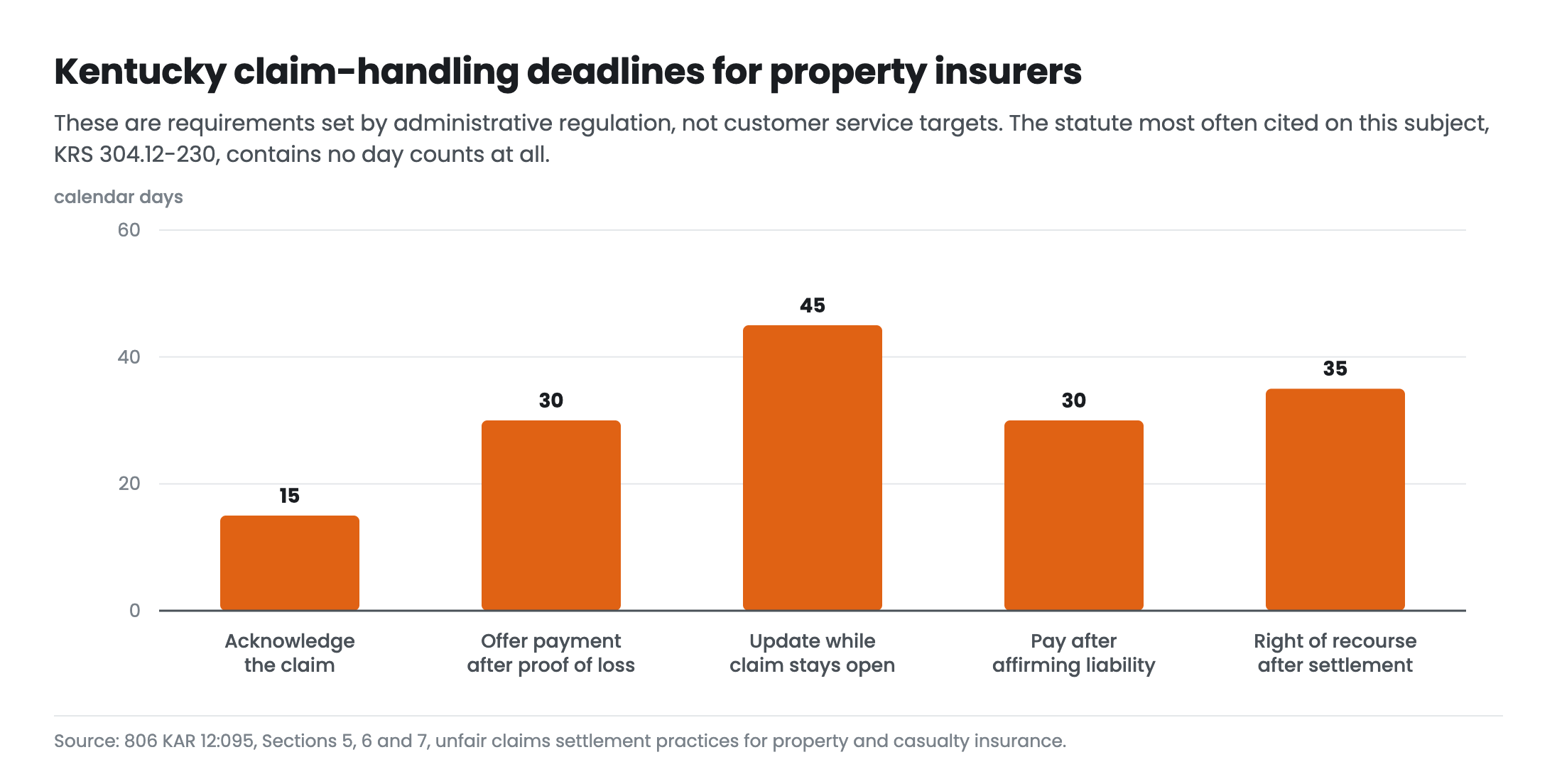
What it does not contain is a single number. The actual day counts live in the administrative regulation underneath it, 806 KAR 12:095. Any page attributing specific deadlines to the statute is citing the wrong document.
What the insurer must do, and when
From 806 KAR 12:095, for property and casualty claims:
- 15 days to acknowledge receipt of notification of a claim, unless payment is made within that period. Sending claim forms within 15 days also satisfies this.
- 15 days to make an appropriate reply on all other pertinent communications from a claimant.
- 30 calendar days from receipt of proof of loss to offer any payment due.
- 30 calendar days from receipt of proof of loss to notify the claimant in writing, with reasons, if more time is needed.
- 45 calendar days from that initial notification, and every 45 days after, to provide an update while a claim stays open.
- 30 days from affirmation of liability to tender payment, where the amount is determined and not in dispute.
- 30 calendar days written notice before any time limit in the policy expires.
- 35 days right of recourse after receipt of a settlement check.
The last two are the ones people miss. An insurer is required to warn a policyholder before a policy deadline runs out, and cashing a settlement check does not immediately end the matter.
What the homeowner’s deadline actually is
Here the answer surprises people. Kentucky law sets no deadline for a homeowner to report property damage. There is no statute and no regulation imposing one. The obligation comes from the policy’s own prompt-notice condition, which is a contract term rather than a legal requirement.
The Kentucky Department of Insurance describes the practical position: “most policies require claims to be filed within one year from the date of disaster.” That is the policy speaking, not the state.
The deadline to sue works similarly. KRS 304.14-370 provides that a policy may not “limit the time for commencing actions against such insurers to a period of less than one (1) year from the time when the cause of action accrues.” That is a floor on how short a policy may make the window, written with respect to foreign insurers. It is not itself a deadline. The policy sets the real one, and most Kentucky homeowners policies set it at one or two years.
The practical consequence is the same either way. Read the policy, because on timing it outranks the statute.
Actual cash value or replacement cost, which decides the size of the check
This single distinction moves more money than everything else on this page combined, and a great many homeowners do not know which one they bought.
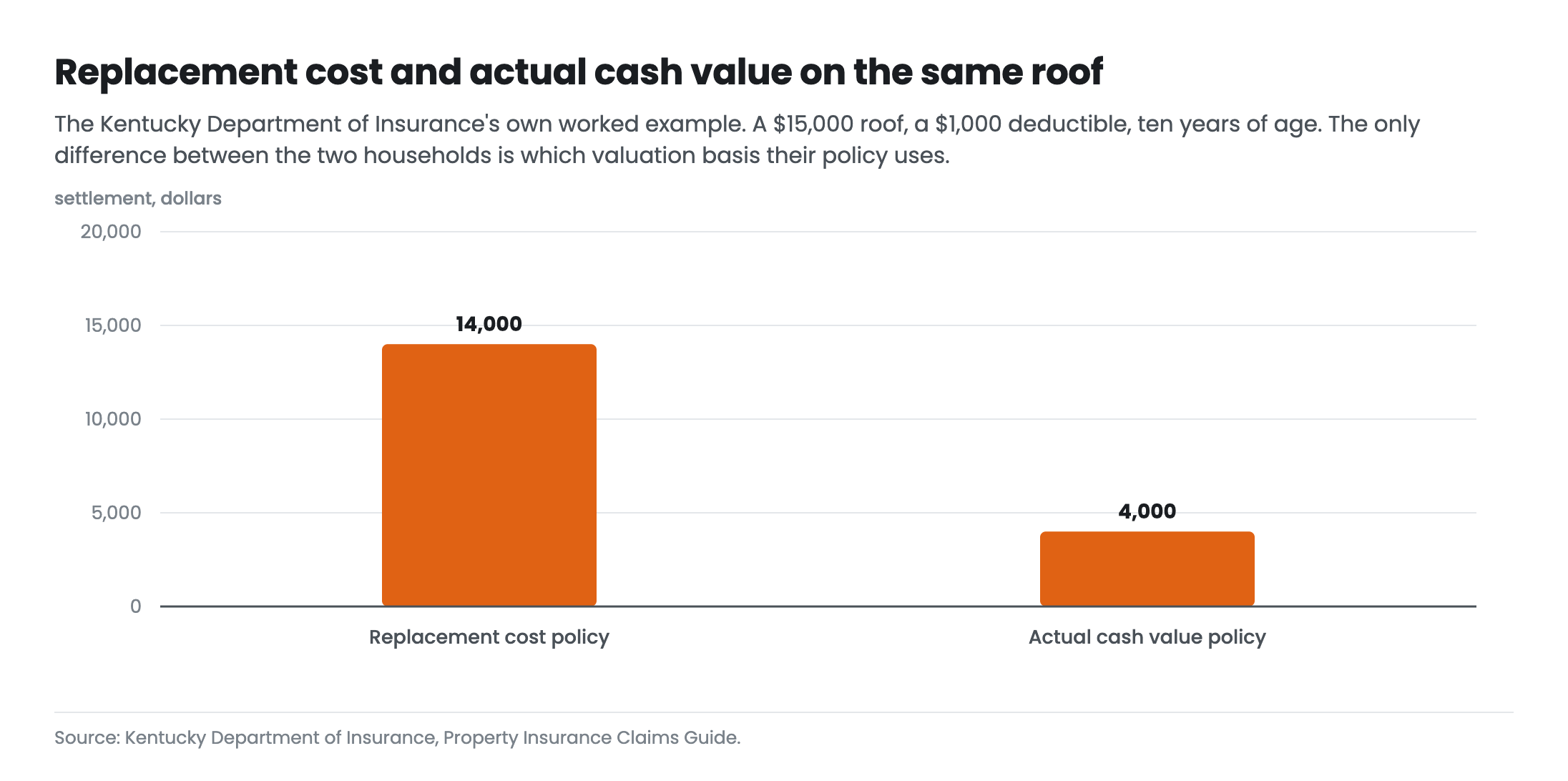
The Kentucky Department of Insurance defines them plainly. Under replacement cost value, “your policy will pay the cost to repair or replace your damaged property without deducting for depreciation.” Under actual cash value, “your policy will pay the depreciated cost to repair or replace your damaged property.”
The Department’s own worked example uses a roof. Two households, each with a $15,000 roof and a $1,000 deductible. The replacement cost household recovers $14,000. The actual cash value household recovers $4,000, the roof having depreciated by $1,000 a year over ten years. Same damage, same deductible, a $10,000 difference.
A separate Department announcement gives the age effect in percentage terms: a 12 year old roof with a 20 year life expectancy pays at roughly 60 percent of replacement cost under actual cash value.
Recoverable depreciation is not automatic
On a replacement cost policy the money usually arrives in two parts. The first payment is the depreciated amount. The balance, which the Department calls “recoverable depreciation,” is released only after the homeowner presents evidence that the work was actually done: “the insurer will pay the difference (this is referred to as ‘recoverable depreciation’) up to the replacement cost.”
Two things follow. Work that never happens never earns the second payment. And the window for claiming it is a policy term rather than a Kentucky rule, so it has to be read off the policy itself.
The matching rule, which is Kentucky’s strongest protection
This is the provision that most changes the outcome of a roof claim, and it is almost entirely absent from what is written on the subject.
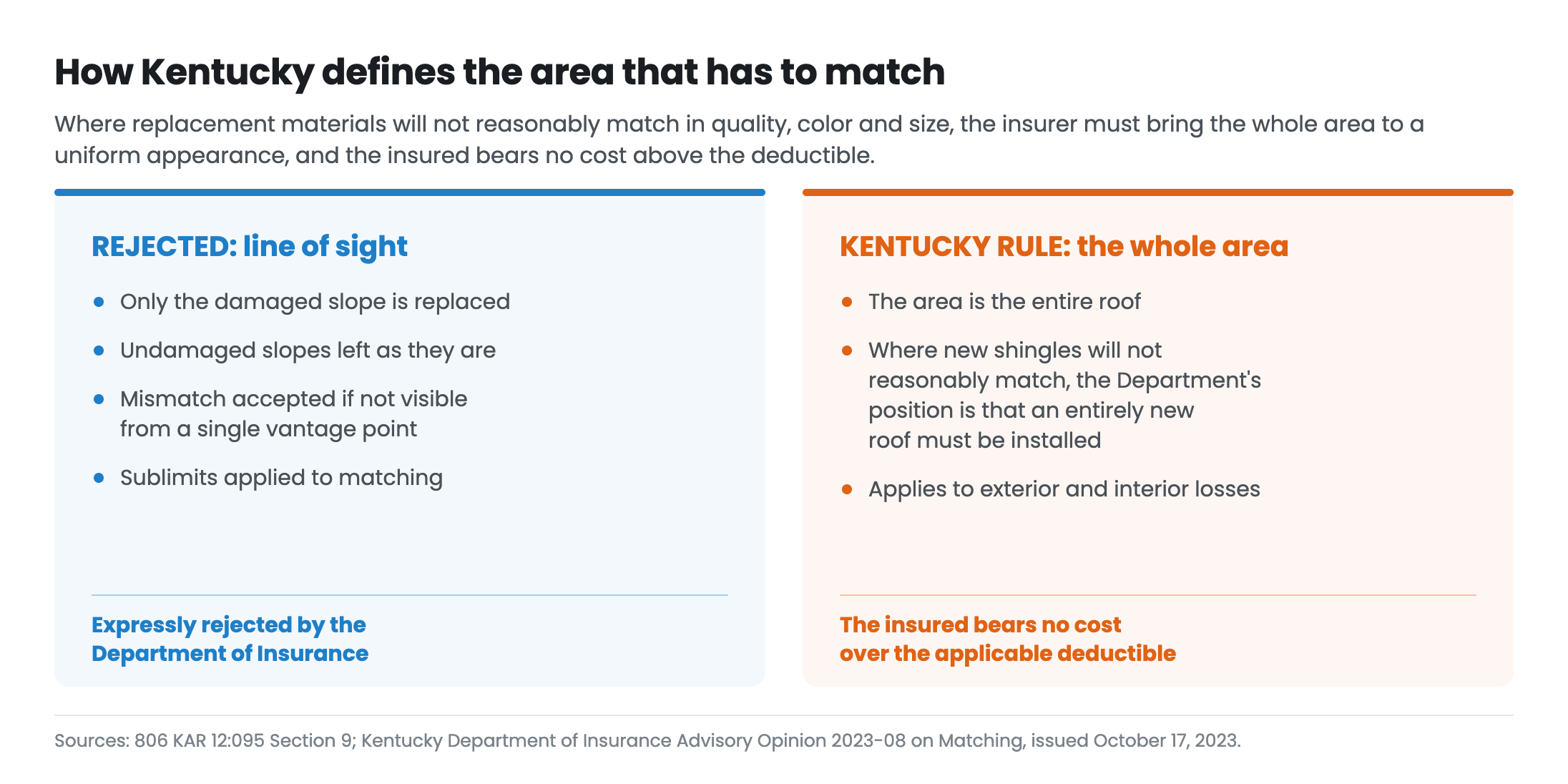
806 KAR 12:095, Section 9, states: “If a loss requires replacement of items and the replaced items do not reasonably match in quality, color, and size, the insurer shall replace all items in the area so as to conform to a reasonably uniform appearance. This applies to interior and exterior losses. The insured shall not bear any cost over the applicable deductible.”
The Department of Insurance then interpreted it, in Advisory Opinion 2023-08, issued October 17, 2023. Three points from that opinion matter for roofs.
It defines the “area.” The Department reads it as “the entirety of a part used for a specific purpose, i.e. an entire roof, an entire contiguous interior carpet, an entire contiguous interior tile floor.” A roof is one area. Not one slope, not one elevation.
It applies the definition to roofs directly. Where one slope requires replacement and the replacement shingles will not reasonably match, the Department’s position is that “an entirely new roof must be installed.”
It rejects the two devices most often used to narrow matching. Line of sight limitations are expressly rejected, as are sublimits on the matching of undamaged areas. Insurers were given until September 1, 2024 to bring non-compliant policy filings into line.
The trigger is worth stating accurately, because the rule is not a blanket entitlement. It applies where replacement items “do not reasonably match in quality, color, and size.” On a roof that is often the case, because shingle lines change and weathered shingles do not match new ones, but it is a matching test rather than an automatic full-roof payout.
Deductibles, and the offer that is against the law
Kentucky permits separate wind and hail deductibles and does not require them. They may be a flat dollar amount or a percentage of the insured value of the home. The Department of Insurance illustrates the difference: a home insured for $135,000 with a 2 percent wind and hail deductible carries $2,700 of exposure before coverage applies, where a flat $2,000 deductible would simply apply as that amount. The Department notes that “many insurance companies are offering higher wind and hail deductibles” to hold premiums down, and urges policyholders to check theirs before renewal rather than after a storm.
Then there is the offer that comes with the door knock. Kentucky prohibits it outright. Under KRS 367.628, where work is expected to be paid from insurance proceeds, a contractor shall not “offer to pay or rebate all or any portion of an insurance deductible or claims proceeds as an inducement to the sale of goods or services.”
The statute closes the obvious workarounds too. A contractor may not grant an allowance or discount against its own fee to achieve the same result, and may not pay the insured more than $100 in any form of compensation, including a bonus, coupon, credit, gift, prize or referral fee. A contractor may not be financially connected, directly or indirectly, to a public adjuster. And a contractor may not cause or encourage damage to increase the scope of work, which the statute additionally treats as a fraudulent insurance act and as criminal mischief in the first degree.
One point of precision, because secondary summaries routinely get it wrong: that criminal escalation attaches to causing damage, not to the deductible provision. Offering to cover a deductible is unlawful under this section. It is not a felony.
The section was last amended by 2026 Ky. Acts ch. 54, effective July 15, 2026, so anything written about it before this summer is quoting older text.
What a roofing contractor may and may not do
This is the part a roofing company has an obvious interest in not telling you, which is a reasonable argument for telling you.
KRS 367.628 opens with a prohibition: a contractor “shall not represent, negotiate, or advertise to represent or negotiate on behalf of any insured on any insurance claim in connection with the provision of goods or services relating to real estate.”
Note that “advertise to represent or negotiate” is in the prohibition. A roofing company promising to handle your claim, fight your insurer, or get your claim approved is not merely overstepping when it does those things. The advertisement itself is the violation.
The same statute sets out what remains permitted. Nothing in it prevents a contractor from “providing an estimate for the provision of goods or services relating to real estate,” or from “conferring with an insurance company’s representative about damage to real estate after a claim has been submitted by an insured.”
Adjusting is a licensed activity. KRS 304.9-430 provides that “no person shall in this state act as or hold himself, herself, or itself out to be an independent, staff, or public adjuster unless then licensed,” and the exemptions in that section do not include contractors. Public adjusters are separately barred by regulation from representing both sides: 806 KAR 9:030 states that a licensed adjuster “shall not represent the interest of both insurer and the insured or claimant,” and must act in a fiduciary capacity for whichever side they serve.
So the honest division of labor is this. A roofer inspects, documents, and writes a line-item estimate, and after a claim is filed can meet the adjuster at the property and discuss the damage. A licensed public adjuster, whom the homeowner pays, negotiates. The homeowner decides. Any offer to collapse those roles is an offer to break a statute.
The Department of Insurance also cautions on assignment of benefits, warning that in signing one “you also may be giving up some, most, or even all of your rights, including having a lawsuit filed without your approval or knowledge,” and advising homeowners to “meet with your insurance company adjuster first, before signing anything with contractors, lawyers or public adjusters.”
What counts as storm damage in Central Kentucky
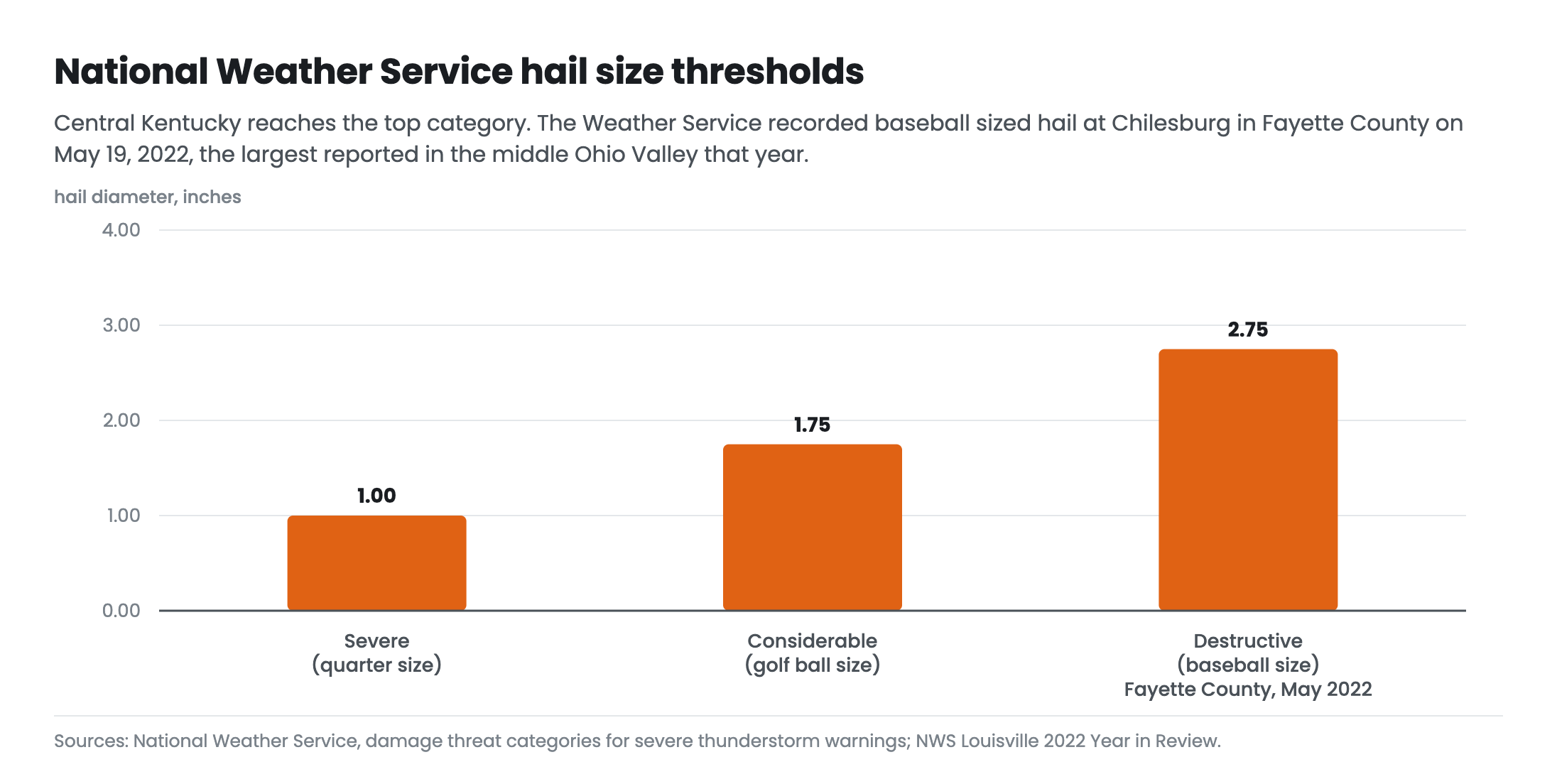
The National Weather Service classifies a thunderstorm as severe once hail reaches 1.00 inch in diameter, roughly the size of a quarter, or winds reach 58 mph. Above that sit two further categories: considerable, at 1.75 inch hail or 70 mph winds, and destructive, at 2.75 inch hail or 80 mph winds. Only around one in ten severe thunderstorms nationally reaches the destructive threshold in a given year.
Central Kentucky reaches it. The National Weather Service office in Louisville recorded baseball sized hail at Chilesburg, inside Fayette County, on May 19, 2022, and described it as the largest hail reported in the middle Ohio Valley that year.
Kentucky is also not a state where homeowners expect this. The Insurance Information Institute, reporting National Weather Service Storm Prediction Center data, counted 5,432 hail events across the United States in 2025, and Kentucky did not appear in the top ten states. That is precisely why roof damage here tends to go unnoticed until a leak appears: the weather is severe enough to do it, and infrequent enough that nobody is looking.
Hail is not the only trigger. Wind that lifts or removes shingles, impact from falling debris, damaged flashing and storm-related leaks are all commonly covered, subject to the policy. What is generally not covered is deterioration from age, which is one reason roof age affects both coverage and valuation.
What to document, before anyone is called
The Kentucky Department of Insurance publishes specific guidance, and following it costs nothing.
Before a storm, keep a record of the property’s condition. The Department recommends photographing or videoing each room and storing that record away from the house, along with copies of the policy. Photographs of the roof and exterior taken while everything is intact are worth a great deal later, because the argument in a denied claim is usually about what the condition was beforehand.
After a storm: contact the insurer promptly. Photograph the damage, which the Department stresses “is very important if you must throw away or move items before the adjuster has seen them.” Keep every receipt for emergency repairs. Get written contractor bids detailing “materials to be used, prices of those materials, and labor on a line-by-line basis,” because a lump sum is difficult to compare and difficult to defend.
On timing, the Department suggests a reasonable adjuster response is three to five days for a minor claim, longer after a widespread event, and that if roughly three days pass after a major disaster with no contact, the Department itself is the place to raise it.
It also warns about the aftermath: “after storms and other disasters, fraudsters and scam artists often arrive quickly,” advises never paying in full before work is complete, and flags contractors offering repairs with “upgraded or free building materials,” which is the same conduct KRS 367.628 prohibits, described from the consumer’s side.
Common questions
Does Kentucky require insurers to replace a whole roof if only part is damaged?
Where the replacement materials do not reasonably match in quality, color and size, yes. 806 KAR 12:095 requires the insurer to replace all items in the area to a reasonably uniform appearance, and the Department of Insurance has defined the area for these purposes as an entire roof. Line of sight limitations are expressly rejected. The condition is that the materials genuinely would not match.
How long does an insurer have to pay a claim in Kentucky?
Under 806 KAR 12:095, an insurer must acknowledge a claim within 15 days, offer any payment due within 30 calendar days of receiving proof of loss, and tender payment within 30 days of affirming liability where the amount is not in dispute. If more time is needed, it must say so in writing within 30 days and update every 45 days after.
Is there a deadline to file a roof claim in Kentucky?
Not one set by Kentucky law. The deadline comes from the policy’s prompt-notice condition. The Department of Insurance notes that most policies require a claim within one year of the date of the disaster, and KRS 304.14-370 prevents a policy from allowing less than one year to bring suit.
Can a roofer pay or waive an insurance deductible in Kentucky?
No. KRS 367.628 prohibits a contractor from offering to pay or rebate any portion of a deductible or claims proceeds as an inducement, from granting an equivalent discount against its own fee, and from paying the insured more than $100 in any form of compensation.
Can a roofing company negotiate a claim on a homeowner’s behalf?
No, unless they are a licensed public adjuster, and a contractor may not be financially connected to one. KRS 367.628 bars a contractor from representing, negotiating, or advertising to represent or negotiate on a claim. A contractor may provide an estimate and confer with the insurer’s representative about the damage once the claim has been submitted.
Why was the settlement so much less than the cost of the roof?
Usually because the policy pays actual cash value rather than replacement cost, or because the replacement cost balance is being held as recoverable depreciation until the work is completed and evidenced. Both are worth checking on the policy declarations before disputing the figure.
Where Ridgepoint fits, and where it does not
Ridgepoint Solutions is a roofing contractor in Lexington, and Kentucky is specific about where that role starts and stops. We think it is worth being just as specific.
We can inspect a roof and tell you what is actually up there. We can document the condition in photographs and in writing. We can put a line-item estimate in your hands, broken down by material and labor, that stands up to comparison. Once you have filed, we can meet your adjuster at the property and talk through the damage itself. If the claim is approved, we do the work.
What we cannot do, and will not offer to do, is negotiate your claim or act for you with your insurer. That is what KRS 367.628 draws a line under, and a roofing company that offers to cross it has told you something useful about how it operates.
If a storm has just been through, start with a roof inspection, or emergency roof repair if water is coming in tonight. Our insurance claim roofing and storm damage repair pages set out how the work is handled, and roof leak repair, roof replacement and roof maintenance cover what usually follows. Materials matter to a matching argument, so shingle roofing and metal roofing are both worth reading, and storms rarely stop at the roof line, which is where siding and gutters come in.
We work across Lexington, Georgetown, Richmond, Frankfort, Nicholasville, Versailles and Wilmore, and handle residential roofing throughout Central Kentucky. There is more in the roofing FAQs, past work in the gallery, and financing if the claim does not cover everything. If permits come up, there is a separate piece on Fayette County roofing permits. About us and contact are both here.
None of the above is legal advice, and it is not a substitute for reading your policy or speaking to the Kentucky Department of Insurance, which takes consumer questions directly.
Sources
- 806 KAR 12:095, Unfair claims settlement practices, property and casualty insurance
- KRS 304.12-230, Unfair claims settlement practices
- KRS 304.14-370, Jurisdiction of courts, limitation of actions
- KRS 367.628, Acts prohibited for contractor
- KRS 304.9-430, Independent, staff, or public adjuster’s license
- 806 KAR 9:030, Adjuster licensing restrictions
- Kentucky Department of Insurance, Advisory Opinion 2023-08 on Matching
- Kentucky Department of Insurance, Property Insurance Claims Guide
- Kentucky Department of Insurance, Consumer Awareness Announcement on Wind and Hail Deductibles
- Kentucky Department of Insurance, Before and After The Storm
- National Weather Service, damage threat categories for severe thunderstorm warnings
- National Weather Service Louisville, 2022 Year in Review
- Insurance Information Institute, Facts and Statistics: Hail